Sustainability
As a global airline, Korean Air pursues social and environmental values with a sense of responsibility and strives for a sustainable tomorrow.
Green management activities
Korean Air strives to resolve global environmental issues, including desertification and yellow dust generation caused by global warming.
- GREEN SKYPASS Project
- In response to climate change and to achieve carbon neutrality, Korean Air launched the GREEN SKYPASS project with SKYPASS members to create an eco-friendly forest.
- Completed the creation of an urban forest in Omok Park, Yangcheon-gu, Seoul (1st phase)
- Created an urban forest in Mullae Neighborhood Park, Yeongdeungpo-gu, Seoul (2nd phase)
- Global Planting Project
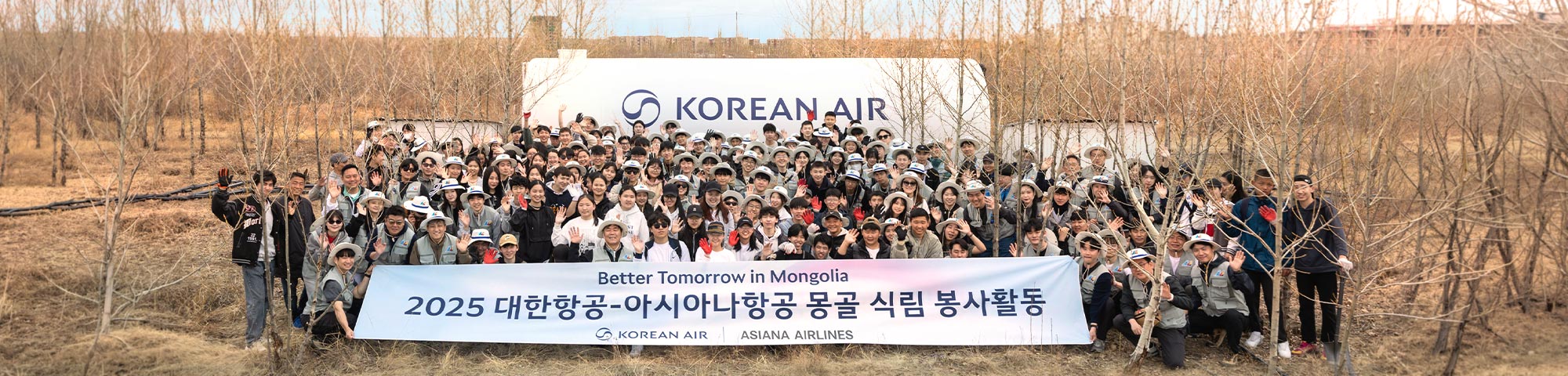
- “Korean Air Forest” in Baganuur, Mongolia
- Contributed to creating the “Korean Air Ecological Forest” in the Kubuqi Desert, Inner Mongolia, China
- Completed the joint promotion and sponsorship of LA green projects with the MTLA (Million Tree LA) Foundation
Response to environmental pollution
We have an organization and system to respond to environmental pollution and are carrying out various prevention activities, ranging from biodiversity protection policies to the management of hazardous chemicals.
- Environmental pollution-related complaint management system
- Established communication procedures within the environmental management regulations for a swift response to environment-related complaints in the field
- Biodiversity protection
- Participating in international activities by recognizing the role of air transportation companies for biodiversity protection
- Management of hazardous chemical substances
- Monitoring hazardous chemical substances and making efforts to switch to eco-friendly materials using an in-house management system to comply with environmental regulations
Response to climate change
Korean Air is making efforts to maximize fuel efficiency and reduce aircraft carbon emissions in order to achieve sustainable growth and minimize environmental impact, while at the same time satisfying the increasing demand for air transportation services.
- Introduction of next-generation environmentally friendly aircraft
- Reducing greenhouse gas emissions by continuously introducing next-generation aircraft, including B787-10
- Utilization of Sustainable Aviation Fuel (SAF)
- Reducing carbon emissions through commercial operations with domestically produced SAF on the Incheon-Haneda, Incheon-Kobe, and Gimpo-Osaka routes