Carry-on Baggage
The carry-on baggage regulations apply to both domestic and international flights.
Allowance by booking class
Allowance by booking class
- Carry-on baggage allowance: One carry-on bag + one personal item
- Carry-on baggage weight: Not exceeding 10 kg in total
Personal item

| Size | Not exceeding 40 cm x 30 cm x 15 cm |
|---|---|
| Permitted items | Handbag, briefcase, laptop bag, etc. |
Carry-on bag

| Size | Within 115 cm (45 in) in total or 55 cm x 40 cm x 20 cm (including handles and wheels) |
|---|---|
| Permitted items | Carry-on suitcase, backpack, Boston bag, etc. |
If you’re traveling in Economy or Premium Class, a personal item is limited to one laptop, briefcase, or personal bag that fits under the seat in front of you.
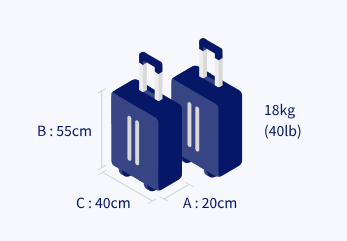
| Pieces | Two carry-on bags |
|---|---|
| Weight | Not exceeding 18 kg (40 lb) in total |
| Size | The sum of the three sides is within 115 cm (45 in) or the maximum dimension is 20 cm (depth A) x 55 cm (height B) x 40 cm (width C) (including handles and wheels) |
Economy/Premium
First/Prestige
Stowing baggage on board
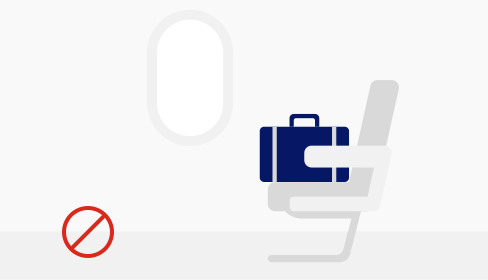
Place it in the overhead bin
If your baggage is bulky, please place it in the overhead bin instead of under the seat. Please ensure the luggage is secure and does not fall while stowing it in the overhead bin.

Place it in the overhead bin
Stow it under the seat
When putting your baggage under the seat, please place it under the seat in front of you instead of under your own seat.


Stow it under the seat
Make sure you do not leave any items behind when leaving the aircraft.
Check the relevant regulations Carry-on regulations for duty-free items Have you purchased any duty-free products for your upcoming flight?
What You Should Know
- Carry-on baggage allowance for codeshare flights may vary by operating airline.
- For in-flight safety and passenger convenience, the use of personal comfort items below is not permitted on board.
- The use of items that may compromise in-flight safety (e.g., obstructing emergency exits and aisles)
- The use of items that may disturb other passengers (e.g., vibration, noise, etc.)
- The use of items that need to be attached to cabin equipment or may damage or place strain on facilities on board
Examples of items not permitted on board the flight
- Carry-on baggage which is too heavy to store in the overhead bin should be checked in. Please understand that passengers are responsible for storing their carry-on baggage, which helps eliminate the risk of cabin crew members damaging carry-on baggage or being injured during assistance.
- Even if your carry-on baggage fits the specifications, it may be processed as checked baggage at the gate due to the lack of storage space on board or the airline’s circumstances.
- Carry-on baggage allowances may vary for some countries depending on their national and airport regulations.
Examples of items not permitted on board the flight
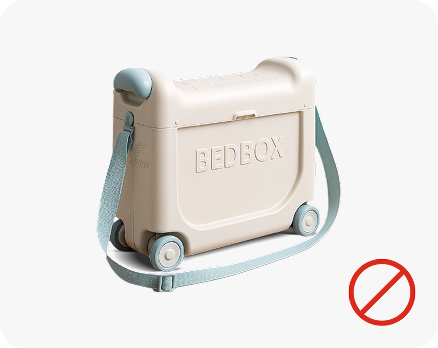
Bedbox
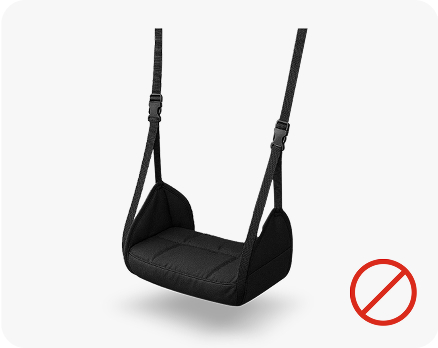
Leg Hammock
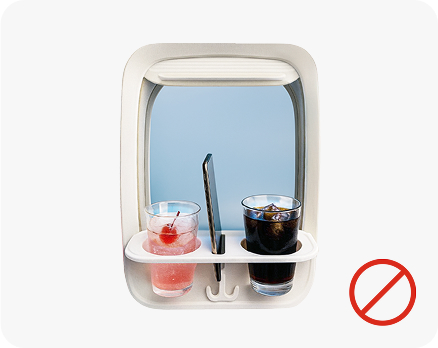
Window Station
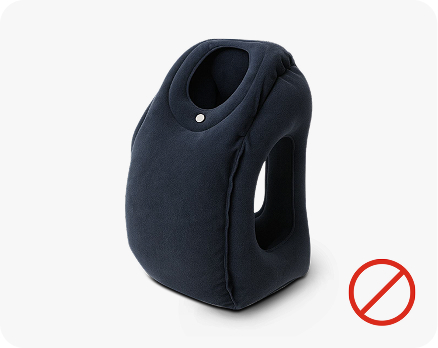
Head Neck Rest Pillow
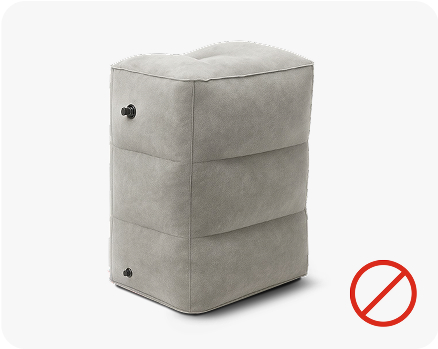
Inflatable Air Pillow
Carry-on regulations for duty-free items
- If duty-free items purchased for personal use exceed the carry-on baggage allowance, they must be checked in as checked baggage at the boarding gate, and an excess baggage fee may apply. However, commercial goods cannot be processed at the boarding gate to ensure on-time aircraft operation and smooth customer service.
- Liquids (e.g., alcoholic beverages, perfume, cosmetics) purchased at a duty-free shop can be carried on board only if they are sealed in a STEB* bag along with the receipt.
- STEB (Security Tamper Evident Bag): A transparent bag manufactured in accordance with the international standards of the ICAO (International Civil Aviation Organization) to indicate whether it has been opened or tampered with after it is sealed.
- If the bag has been opened or damaged before boarding, it cannot be carried on board, so please ensure the packaging remains intact. Opened items will be handled in accordance with local security regulations.
- Even if sealed, carrying liquid duty-free items on board may be restricted according to the security regulations of the country of departure or transfer.