Guide
How to travel with your beloved pets
From transportation approval to boarding, check all necessary information to make sure your pets travel safely.

Pets permitted on board
How to use
STEP 1
Check country-specific regulations
- Check and prepare required documents for each destination such as a rabies vaccination certificate, quarantine certificate, etc.
STEP 2
Obtain quarantine certificate
- Depending on your origin airport, you may be required to visit a quarantine station, and the timing of your pet's quarantine may vary (such as on the day of boarding or in advance). Check with the quarantine office at your origin airport in advance.
STEP 3
Prepare a pet carrier
- Depending on the weight of your pet and the method of transportation, please check the conditions of the carrier and prepare accordingly.
STEP 4
Request transportation of accompanying pets
After purchasing a flight ticket, please verify transportation eligibility at least 48 hours before for international flights and 24 hours before for domestic flights
If transportable: You will receive a notification (Alim Talk, SMS message, e-mail) and a pet transportation declaration form to fill out 7 days before your departure date.
If not transportable: The reason for the rejection can be found in your booking details.
- If you have applied to travel with a pet on board, please select a seat designated for pet travel.
STEP 5
Arriving and checking in at the airport
- Please arrive at the airport with enough time for the pet travel process.
- Even if you have paid in advance through the Korean Air website, your fare may be recalculated based on the weight measured at check-in on the day of travel.
STEP 6
Flying with pets
- When bringing a pet on board, please keep your pet in a pet carrier and store the carrier under the seat in front of you.
- When transported in the cargo hold, pets are placed in a compartment with controlled ventilation, temperature, and lighting.
Pet travel fare
This fare must be paid separately from baggage You can pay with a credit card, mileage, or SKYPETS points Information on pet travel fare You can pay in a variety of ways
Petiquette
Please be sure to follow proper petiquette for both your pet and other passengers while on board. Precautions for traveling with pets Please review these guidelines if you are traveling with your pet.
What you should know
- You need to purchase a ticket to request the Traveling with Pets service.
- To travel with a pet on board, you need to select a seat designated for traveling with a pet.
- Please note that if you arrive at the airport without approval, your pet will neither be able to fly with you onboard nor be transported in the cargo hold.
- Codeshare flight passengers may or may not be able to travel with pets depending on the policy of the codeshare partner. Please contact the Korean Air Service Center for further details.
- In case you transport your pet for a commercial purpose, such as sales, adoption, event attendance, breeding, or research, the pet may not be allowed to enter depending on the regulations of the destination country.
- Restrictions on traveling with a pet will vary depending on the aircraft, cabin class, and entry/exit regulations at the specific airport.
- A pet stroller is considered regular baggage and can be transported free of charge if it is included in the free baggage allowance.
- Passengers traveling with pets are restricted from exit row seats because they may have difficulty performing safety duties in an emergency.
Pets permitted on board
- Dogs, cats, and pet birds over eight weeks old
- 16 weeks of age or older if checked in the cargo hold
- Number of animals you can transport: You can transport one animal per passenger on-board and two in the cargo hold.
- If you have a pair of birds, two dogs under six months old, or two cats, you can ship them in one transportation container.
Pets that are restricted from traveling
Transport restrictions
Ferocious dogs as stated in the Enforcement Rule of the Animal Protection Act or pets with violent tendencies
Pets that have been given drugs, such as stabilizers or sleeping pills
Pregnant pets or pets with a strong odor
Snub-nosed breeds (including mixed breeds between a snub-nosed breed and a non-snub-nosed breed), which have the risk of respiratory problems or death during a flight, cannot travel in the cargo hold (in-flight travel allowed only when boarding conditions are met)
Ferocious dogs
- Tosa and its mixed breeds
Pit Bull Terrier and its mixed breeds (including American Pit Bull Terrier, Bull Terrier, American Staffordshire Terrier, Staffordshire Bull Terrier)
Rottweiler and its mixed breeds
Mastiff and its mixed breeds
Laika and its mixed breeds
Ovcharka and its mixed breeds
Kangal and its mixed breeds
Wolfdog and its mixed breeds
Brachycephalic (snub-nosed) breeds
Brachycephalic (snub-nosed) breeds refer to breeds with muzzles shorter than their skulls


Dogs: Newfoundland, Dogo Argentino, Dogue de Bordeaux, Lhasa Apso, Boston Terrier, Boxer, Bulldog, Brussels Griffon, Shar Pei, English Toy Spaniel, Shih Tzu, American Bully, Affenpinscher, Chihuahua, Japanese Chin, Chow Chow, Cane Corso, King Charles Spaniel, Cavalier King Charles Spaniel, Pug, Pekingese, Tibetan Spaniel
Cats: Burmese, British Shorthair, Scottish Fold, Exotic, Persian, Himalayan
How to transport pets
How to transport pets
Pet conditions
- 8 weeks or older
- Total weight of the pet and pet carrier must be 7 kg (15 lb) or less
Pet carrier
- Up to 32 cm (12.5 in) wide x 45 cm (17.5 in) deep x 19 cm (7.5 in) high (up to 19 cm high including wheels)
- Soft carriers up to 25 cm (10 in) high are permitted, provided they are not more than 19 cm high when pressed down.
- Pet carriers must fit under a seat.
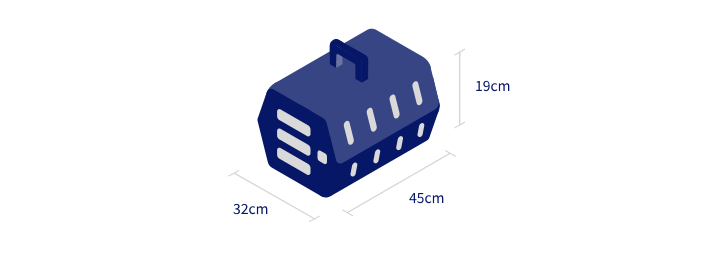
Pet carrier conditions
- Enough space for pets to stand, lie, and move in a pet carrier
- Water resistant and equipped with proper ventilation
- Cannot be opened with force from the inside
- Fastened securely with screws and made of sturdy materials, such as metal, wood, and plastic
- Soft material carrier, such as fabric or leather, for on-board pet transport
- When transporting a pet in the cabin in a soft carrier made of fabric or leather, a carrier designed for in-flight use with a firm floor and sides is required
- Please see the link below for detailed pet carrier conditions
IATA Traveler's Pet Corner
Please note
- Ensure your name and telephone number are written in English and attached to the outside of the carrier.
- You cannot modify or expand the pet carrier after boarding. We ask that you fully cooperate with cabin crew requests for handling your pet on board.
Pet conditions
- 16 weeks or older
- Total weight of the pet and pet carrier must be 45 kg (99 lb) or less
Pet carrier
- Sum of length x width x height 291 cm (114 in) or less (up to 84 cm (33 in) high)
- Transport may be restricted when exceeding 32 kg (70 lb) in some countries.
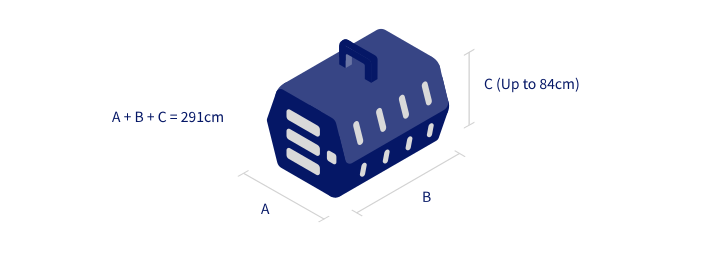
Pet carrier conditions
- Enough space for pets to stand, lie, and move in a pet carrier
- Water resistant and equipped with proper ventilation
- Cannot be opened with force from the inside
- Fastened securely with screws and made of sturdy materials, such as wood or plastic
- Immobile and removal of wheels and other accessories
- Please see the link below for detailed pet carrier conditions
IATA Traveler’s Pet Corner
Please note
- Ensure your name and telephone number are written in English and attached to the outside of the carrier.
- Transporting your pet in temperatures above 29 degrees Celsius (84°F) or below -7 degrees Celsius (19°F) can adversely affect your pet’s health.
- If you want to provide water for your pet during transportation, you'll need to prepare in advance and securely and sturdily mount a dedicated watering station on the door or inside the crate.
- To ensure the safe transportation of pets, checked pet transport is restricted on Boeing 737 and Airbus A321 aircraft for all international flights and during the warm season (June through September) for domestic flights.
Cabin (7 kg (15 lb) or less)
Cargo hold (45 kg (99 lb) or less)
Pet travel regulations
Documents necessary for pet travel
- Domestic flights: N/A
International flights: Please check with the quarantine office of the airport or the embassy at the origin/destination as regulations vary by country.
Pet restrictions by country
- Below are regulations from countries with stricter regulations. The regulations are subject to change in accordance with the policies of the respective countries. Please contact the authority of the respective countries for detailed information.
- For pets from rabies-free countries or under 90 days old regardless of region, a microchip must be implanted, a quarantine certificate issued by a government is required and the microchip identification number must be marked on the certificate.
- Pets from high-risk countries for rabies, and dogs and cats 90 days or older must observe the conditions above, and the quarantine certificate must clearly indicate that a “rabies-neutralizing antibody” test has been administered by an internationally recognized testing body or a government agency within 24 months of intended travel, and that the result at the time of the test was 0.5 IU/ml or higher.
- All pets entering Korea must visit the Animal Quarantine office located inside the arrival hall to complete import declaration and inspection before passing through the customs area.
For the list of rabies-free countries and other information, please visit the Animal and Plant Quarantine Agency website.
New Zealand
- Due to government regulations in New Zealand, pets are not accepted in the cabin or as checked baggage.
Pets departing from New Zealand can travel only in a sturdy pet carrier. (Including pets traveling in the cabin)
For more information, please visit the government of New Zealand website.
Australia
- Due to government regulations in Australia, pets are not accepted in the cabin or as checked baggage.
For more information, please visit the government of Australia website.
Singapore
Taking your pet from/to Singapore or transferring in Singapore with your pet requires a license from the Animal & Veterinary Service of Singapore.
For more information, please visit the Animal & Veterinary Service of Singapore website.
Hong Kong (China)
Due to government regulations in Hong Kong, pets are not accepted on-board or as checked baggage.
For more information, please visit the government of Hong Kong website.
Due to government regulations in the UK, pets are not accepted in the cabin or as checked baggage.
For more information, please visit the government of UK website.
- For pets traveling to Japan, the arrival date must be notified to the quarantine authorities of Japan and a “pet inspection approval” document must be issued at the latest by 40 days prior to arrival.
Other requirements
- Microchip implant
- After birth or after leaving Japan, your pet must stay in a designated region for at least 180 days before entering Japan
- Proof that the country in which it stayed has been free of rabies for the past 2 years
- No sign of rabies or Leptospira symptoms at the time of departure
- A dog or cat traveling to Japan from a designated region may be released within 12 hours if the requirements above are met
- A dog or cat traveling to Japan from a region other than a designated one may be released within 12 hours if the requirements above and the additional conditions below are met
- A microchip is implanted and rabies vaccines are administered twice
- A blood test is conducted by a Japanese government-approved lab and the required rabies antibody-related scores are recorded
- An elapsed time of between 180 days and 2 years after the blood test is required In the event that the period of 180 days has not passed at the time of arrival, the pet must stay at a quarantine facility until the 180 days have passed
- No sign of rabies or Leptospira symptoms at the time of departure
If the requirements above are not met, the pet must stay at a quarantine facility for 180 days. For the list of designated regions and other details, please visit the Japanese government website.
Traveling with a dog or cat from a non-rabies-free country into Canada
- A rabies vaccination certificate issued by a vet is required. (English or French)
The certificate should indicate the type of rabies vaccine used, date administered, and expiry date, as well as the ID number.
Traveling with a dog or cat from a rabies-free country into Canada
A certificate stating that there have been no cases of rabies in the country in the past six months is required.
It must be issued by a government-certified vet and must include the identification number.
Puppies or kittens under three months old are exempt from the rabies-related requirements mentioned above.
Birds from countries other than the U.S. can only enter Canada if accompanied by an import permit, which must be obtained prior to arrival in Canada.
For the list of rabies-free countries recognized by the Canadian government and other details, please visit the government of Canada website.
If the pet is traveling in the cargo hold of the flight from/to Canada
- The pet carrier must be equipped with a water bottle as per the Canadian government regulations.
Ontario
- Due to government regulations in Ontario, pit bulls are not accepted in the cabin or as checked baggage or as cargo for travel into (or via) Ontario. Breeds classified as pit bulls are the Pit Bull Terrier and Staffordshire Terrier. For more information, please visit the government of Ontario website.
- Any pet traveling to EU countries from a third country must meet the following requirements.
- The pet must be implanted with a microchip and the ID number must be marked on the certificate.
- For pets traveling from a third country other than Andorra, Croatia, Ireland, Lichtenstein, Norway, San Marino, Switzerland, or the Vatican
- A health certificate issued by a certified veterinarian is required (valid for 10 days from the date of issue).
- In some countries, separate requirements apply to pets that are less than three months old. Please check with the countries for details.
For more details, please visit the EU website.
- Eligibility: Passengers traveling with pet dogs on flights arriving in the United States on or after August 1, 2024
- Required conditions
- At least six months old
- Microchip implanted
- Approved CDC Dog Import Form
The required documentation depends on your departure location and where your pet got vaccinated. Please see the documentation details below to prepare in advance.
- Preparing documents
- As this depends on your departure and vaccination location, please check the CDC website
- Dogs that have received a foreign rabies vaccine and are traveling to the United States from a high-risk country on Korean Air may only enter through Washington Dulles Airport (IAD) and Hartsfield-Jackson Atlanta International Airport (ATL).
View the CDC high-risk countries list
- Transport of pets for commercial purposes—such as sale, adoption, event participation, breeding, or research—may be denied entry.
For Hawaii, you must meet both the federal and the state quarantine regulations.
Hawaii is a rabies-free region and all pets are subject to a 120-day quarantine upon entry. However, if the quarantine agency’s specific requirements are met, your pets can qualify for the Direct Release or 5 Day or Less Release Program.
The cost of quarantine must be paid by the owner of the pet.
Direct Release or 5 Day or Less Release Program
- Step 1. Rabies vaccination
- The pet must have been vaccinated at least twice (at least 30 days apart).
- The most recent rabies vaccination must have been administered at least 90 days prior to the date of arrival in Hawaii. However, the expiration date must not have passed.
- The date of vaccination and the type of vaccine must be indicated on the certificate.
- Step 2. Microchip
- The pet must be implanted with a microchip. (Implanted before the OIE-FAVN rabies blood test)
- If a microchip does not scan, the Direct Release or 5 Day or Less Release Program does not apply.
OIE-FAVN rabies blood test
- A test sample must have been received by KSU (Kansas State University) or DOD between 36 months and 120 days before the date of arrival in Hawaii.
- The test result must be 0.5 IU/ml or higher.
- Documents
- Original ink signature or carbon copy of the rabies vaccination certificate for two most recent rabies vaccinations (photos of the certificates and computer-generated certificates not accepted)
- Original ink signature of health certificate that displays the treatment result of the pet for ticks within 14 days prior to arrival in Hawaii.
- Send documents ① and ② to Animal Quarantine Station, 99-951 Halawa Valley Street, Aiea, Hawaii 96701 at the latest by 10 days prior to arrival in Hawaii.
① Dog & Cat Import Form AQS-278
② Two original ink signature copies of rabies vaccination certificate
- Cost (USD 165 for direct airport release, USD 224 for 5 Day or Less Release Program)
Direct Release Program
- Direct Release Program is only available at Honolulu International Airport.
Arrive at the quarantine office in the airport between the inspection hours of 8:00 AM and 5:00 PM (subject to change without notice).
Your pet will not qualify for direct release if ticks or other parasites are detected
Direct release will not be possible if prohibited by the airport security authorities.
For more details, please visit the website of the government of Hawaii.
Republic of Korea
United States
Hawaii (U.S.)
New Zealand/Australia
Singapore/Hong Kong (China)
United Kingdom
Japan
Canada
EU
Information on pet travel fare
The fare can be paid after the pet travel is approved.
The fare can be paid on the Korean Air website or at the airport on the date of departure.
Cash/card payment fee
Cash/card payment fee
Domestic flights
Domestic flights
30,000 KRW
International flights
KRW – ₩
Short-haul
150,000 KRW
Medium-haul
225,000 KRW
Long-haul
300,000 KRW
USD – $
Short-haul
150 USD
Medium-haul
225 USD
Long-haul
300 USD
CAD – $
Short-haul
150 CAD
Medium-haul
225 CAD
Long-haul
300 CAD
IDR – Rp
Short-haul
2,140,000 IDR
Medium-haul
3,296,000 IDR
Long-haul
4,280,000 IDR
- The total weight is the sum of the weight of the pet carrier and the pet.
- Fares are based on one-way travel departing from Korea and charged according to the currency of the country of departure.
- When the currency of the country of departure is not KRW, USD, CAD, or IDR, the USD fare exchanged for the local currency is charged. For further details, please contact the Service Center.
- When transferring to an international route, an additional fee may be charged depending on the contract between Korean Air and the connecting airline.
- Fee based on the transport method (cabin, cargo hold) is the same.
Domestic flights
Domestic flights
60,000 KRW
International flights
KRW – ₩
Short-haul
300,000 KRW
Medium-haul
450,000 KRW
Long-haul
600,000 KRW
USD – $
Short-haul
300 USD
Medium-haul
450 USD
Long-haul
600 USD
CAD – $
Short-haul
300 CAD
Medium-haul
450 CAD
Long-haul
600 CAD
IDR – Rp
Short-haul
4,280,000 IDR
Medium-haul
6,592,000 IDR
Long-haul
8,560,000 IDR
- The total weight is the sum of the weight of the pet carrier and the pet.
- Fares are based on one-way travel departing from Korea and charged according to the currency of the country of departure.
- When the currency of the country of departure is not KRW, USD, CAD, or IDR, the USD fare exchanged for the local currency is charged. For further details, please contact the Service Center.
- When transferring to an international route, an additional fee may be charged depending on the contract between Korean Air and the connecting airline.
- Fee based on the transport method (cabin, cargo hold) is the same.
32 kg (70 lb) or less
33–45 kg (73–99 lb)
Paying with mileage
- You can pay the pet travel fare with your mileage.
- You can use the Family Plan.
- You can first check the miles you need to redeem for pet services and then pay in advance.
Redeeming mileage for pets
Paying with SKYPETS points
- You can use your previously collected SKYPETS points to transport your pet for free.
Points accrual and use
How to request the Traveling with Pets service in advance
The Traveling with Pets service is subject to prior reservation and approval.
Deadline for reservations
- International flights: At least 48 hours prior to the flight departure
- Domestic flights within Korea: At least 24 hours prior to the flight departure
Check pet transportation request results
- If transportable
- You will receive a notification (KakaoTalk message, text message, or email).
- You will also receive a pet transportation declaration form to fill out 7 days before your departure date.
- If not transportable
- The reason for the rejection can be confirmed in your booking details.
How to check if your request has been approved
The Traveling with Pets service is subject to prior reservation and approval.
- You will receive a notification (Alim Talk, SMS message, e-mail) and a pet transportation declaration form to fill out 7 days before your departure date.
- If approval is denied, the reason for the rejection can be confirmed in your booking details.
Precautions for traveling with pets
If you’re traveling with your pet on board, please follow pet etiquette to keep everyone safe and comfortable.
When traveling with pets on board
- Pets are not allowed to be removed from their pet carrier in lounges or on board.
- Please keep the pet carrier closed at all times, as your pet may cause discomfort or allergies to other passengers.
- Please keep your pet carrier under your assigned seat at all times, as the aircraft may experience turbulence and your pet may get injured.
- To prevent obstructions in the event of an emergency escape, changing the shape of or expanding the pet carrier is prohibited.
- Please prepare a clean pet carrier and line the bottom with paper, towels, blankets or absorbent pads. Absorbent pads cannot be replaced on board.
- Please prepare a muzzle in case your pet makes noise, such as barking, and cooperate with the cabin crew’s requests in case of emergency.
- Violations of the above may result in warnings or restrictions by the cabin crew, and continued violations may result in your pet not being allowed on board.
Provision of food
- Please give your pet food and water at least 2 hours before your flight.
- The International Air Transport Association recommends feeding your pet a light meal at least 2 hours before departure to keep them healthy, and generally no additional food is needed for another 12 hours.
- Please consult with your veterinarian, as this may vary depending on the type, size and health of your pet.
- On board, if necessary, you can give your pet food you brought (excluding treats) and water provided to you, but only through an external feeding device without opening the pet carrier.
- Please check the regulations of your destination country and airport, as the import or export of food and other items depends on the quarantine and customs regulations of your destination.
Short-haul: Japan, China, Taiwan, Hong Kong, Macao, Mongolia
Medium-haul: Southeast Asia, Southwest Asia (including Guam and Palau)
Long-haul: The Americas, Europe, Middle East, Africa, Oceania